Spring Equinox

What Happens at the Equinox?
Far from being an arbitrary indicator of the changing seasons, March 20 (March 21 in some years) is significant for astronomical reasons. On March 20, 2010, at precisely 1:32 P.M. EDT (March 20, 17:32 Universal Time), the Sun will cross directly over the Earth’s equator. This moment is known as the vernal equinox in the Northern Hemisphere. For the Southern Hemisphere, this is the moment of the autumnal equinox.

Equinox Means “Equal Night”
Translated literally, equinox means “equal night.” Because the Sun is positioned above the equator, day and night are about equal in length all over the world during the equinoxes. A second equinox occurs each year on September 22 or 23; in 2010, it will be on September 22 at 11:09 P.M. EDT. This date will mark the autumnal equinox in the Northern Hemisphere and the vernal equinox in the Southern (vernal denotes “spring”).

Reasons for the Seasons
These brief but monumental moments owe their significance to the 23.4 degree tilt of the Earth’s axis. Because of the tilt, we receive the Sun’s rays most directly in the summer. In the winter, when we are tilted away from the Sun, the rays pass through the atmosphere at a greater slant, bringing lower temperatures. If the Earth rotated on an axis perpendicular to the plane of the Earth’s orbit around the Sun, there would be no variation in day lengths or temperatures throughout the year, and we would not have seasons.

Rituals and Traditions
Modern astronomy aside, people have recognized the vernal equinox for thousands of years. There is no shortage of rituals and traditions surrounding the coming of spring. Many early peoples celebrated for the basic reason that their food supplies would soon be restored. The date is significant in Christianity because Easter always falls on the first Sunday after the first full moon after the vernal equinox. It is also probably no coincidence that early Egyptians built the Great Sphinx so that it points directly toward the rising Sun on the day of the vernal equinox.

The first day of spring also marks the beginning of Nowruz, the Persian New Year. The celebration lasts 13 days and is rooted in the 3,000-year-old tradition of Zorastrianism.

Category Esoterica, Physics Tags

Holes In Heaven: H.A.A.R.P. and Advances in Telsa Technology

Examines the controversial military program based on Tesla technology – its’ possible effects on weather and use in mind control.

Category Military and Govt. Ops, Physics Tags , , , ,

Galileo Galilei

Doubt is the father of invention.

Category Quotes Tags ,

Gobekli Tepe – Turkey: Reshaping Human History – 12,000 Years Old

Göbekli Tepe, is a hilltop sanctuary erected on the highest point of an elongated mountain ridge some 15 km northeast of the town of Şanlıurfa, in southeastern Turkey and 500 miles away from Istanbul, Turkey. It is the most astonishing archaeological discovery in modern times and also thought to be the oldest advanced civilization on Earth.


Category Anthropology, Archaeology Tags , ,

Native Elder

Category Anthropology, Art & Design Tags , ,

World’s Largest Pyramid Discovered, Lost Mayan City Of Mirador, Guatemala

http://www.youtube.com/watch?v=BBw_m1vBiIo


Category Archaeology, Videos Tags , ,

Salman Rushdie

The only people who see the whole picture,’ he murmured, ‘are the ones who step out of the frame.

Category Quotes Tags ,

New Theory Nixes “Dark Energy”: Says Time is Disappearing from the Universe

Remember a little thing called the space-time continuum? Well what if the time part of the equation was literally running out? New evidence is suggesting that time is slowly disappearing from our universe, and will one day vanish completely. This radical new theory may explain a cosmological mystery that has baffled scientists for years.

Scientists previously have measured the light from distant exploding stars to show that the universe is expanding at an accelerating rate. They assumed that these supernovae are spreading apart faster as the universe ages. Physicists also assumed that a kind of anti-gravitational force must be driving the galaxies apart, and started to call this unidentified force “dark energy”. However, to this day no one actually knows what dark energy is, or where it comes from.

Professor Jose Senovilla, and his colleagues at the University of the Basque Country in Bilbao, Spain, have proposed a mind-bending alternative. They propose that there is no such thing as dark energy at all, and we’re looking at things backwards. Senovilla proposes that we have been fooled into thinking the expansion of the universe is accelerating, when in reality, time itself is slowing down. At an everyday level, the change would not be perceptible. However, it would be obvious from cosmic scale measurements tracking the course of the universe over billions of years. The change would be infinitesimally slow from a human perspective, but in terms of the vast perspective of cosmology, the study of ancient light from suns that shone billions of years ago, it could easily be measured.

from: The Daily Galaxy

Category Physics Tags , ,

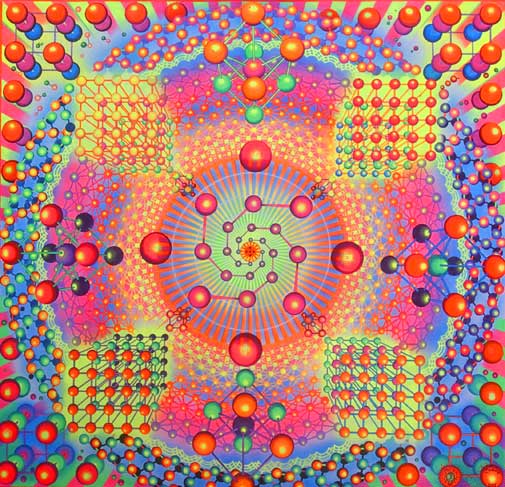
Many Mansions

Category Art & Design, Chemistry, Sacred Geometry Tags , ,

Ralph Waldo Emerson

A chief event of life is the day in which we have encountered a mind that startled us.

Category Quotes Tags ,

Swami Vivekananda

All the powers in the universe are already ours. It is we who have put our hands before our eyes and cry that it is dark.

Category Quotes Tags ,

The Vision of Viktor Schauberger

Nature was my Teacher – The Vision of Viktor Schauberger (1 of 5)

Viktor Schauberger was an Austrian inventor and naturalist who built and patented a water ram pump involving a spiral flow which he claimed to have learned from a visit to the Egyptian pyramid. Schauberger is considered the father of implosion technology. Many of his inventions are based on his study of fluidic vortexes.

Viktor Schauberger was born in Holzschlag, Austria in 1885. Growing up in a family of forest workers led Schauberger to study the physics of the forest. He researched water flow and other natural phenomena.Beginning in 1929, Schauberger began patenting inventions based on water engineering. Schauberger built a water turbine to produce hydroelectricity.

During World War II, Schauberger was forced by the German SS to continue his research into vortex technology to aid in the design of German planes and even a type of fly saucer (the Repulsin). The stress led to his mental breakdown and hospitalization. After the war, Viktor Schauberger began his research on vortex technology and invented water-power turbines.In 1958, at the age of seventy-three, Viktor Schauberger died in Linz, Austria.

Category Free Energy, Military and Govt. Ops, Physics, UFOs, Videos Tags , , , ,